

Why Chasing Returns Does Not Work and Why Asset Allocation Does
November 16, 2021 | Investing, Saving & Investing
Chasing Returns
The next time you are stuck in big city traffic on the freeway, watch the cars that are weaving in and out of traffic. Some drivers will jump from a slower moving lane to a faster one hoping to get to their destination more quickly. Then a minute or two later, you will pass them when their previously faster-moving lane comes to a complete stop. Efforts dashing from one lane to another may slow down these drivers’ arrival to their destination while creating a greater risk of a wreck.
Just like drivers who constantly shift from slower moving lanes to faster moving lanes, some investors will jump from investment to investment, selling those that have not performed well recently and buying those that are “hot.” This behavior is known as chasing returns, and there is a scientific explanation for why we do it. Among our many biases, humans are subject to something known as “recency bias.” We tend to look at recent information and value it as more important than previous information. Since we make so many decisions all day, our brains create shortcuts to reduce cognitive load, preferring readily accessible information in our recent memory over the hard work of thinking, research, and analysis. Our brains can deceive us because when it comes to investing, an investment that is outperforming now may not outperform in the future.
A Real-World Example
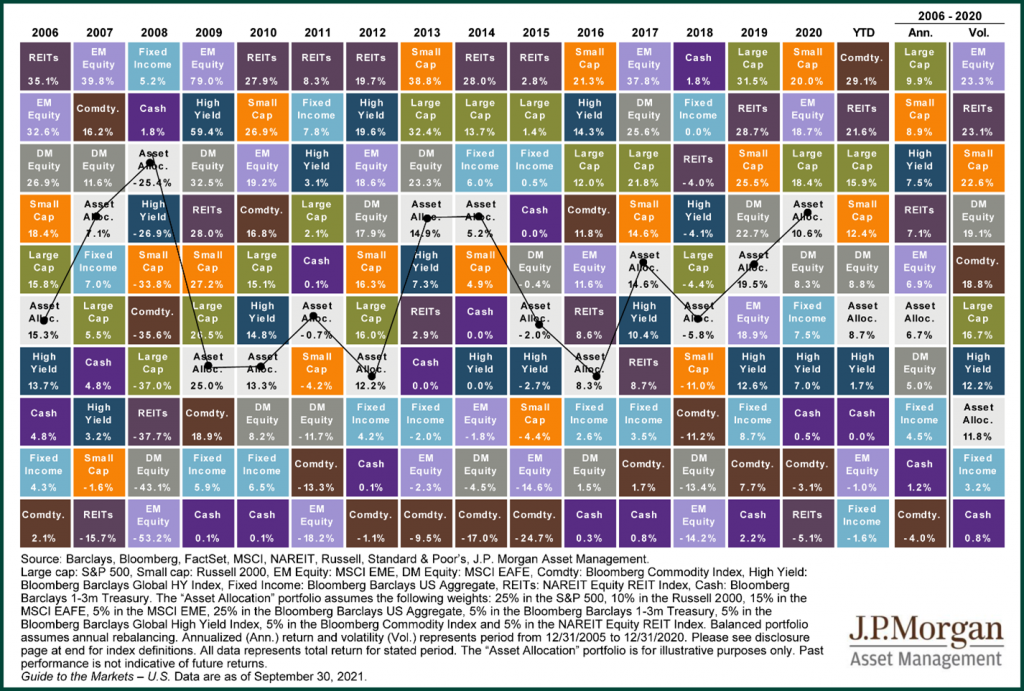
Here is a real-world example showing why chasing returns does not work. This chart shows the performance of nine different asset classes over the past fifteen years, ranked from the best performer at the top to the worst performer at the bottom for each calendar year. Imagine yourself as someone who likes chasing returns. At the beginning of 2007, you would have invested in REITs (real estate) since it was the best performer the previous year with a 35.1% return. This would not have worked out well for you since REITs, the best performing asset class in 2006, was the worst performer in 2007 losing 15.7%. What would you have done at the end of your disastrous year in 2007? You would have likely sold your REITs and invested in Emerging Markets Equity, which up 39.8% in 2007. That would have been another poor move, as Emerging Markets Equity lost 53.2% in 2008, fairing far worse than other investments during the Great Recession and financial crisis.
After the stock market crash of 2008, many investors moved their money to safer investments like Fixed Income and cash, which did not lose money that year. These investors not only missed out on the subsequent stock market recovery in the following years but locked in their 2008 losses. Just like drivers dodging in and out of traffic lanes in freeway traffic, moving out of lower performing investments and into the past year’s best performing investments is usually a losing strategy and may be detrimental to your financial future. This is where asset allocation comes in.
Asset Allocation
Asset allocation is the process of combining different asset classes, or types of investments, with the goal of achieving the highest return for a given amount of risk, since different types of asset classes are not perfectly correlated (they do not necessarily move up and down together). Revisiting our chart above, you can see that there is no pattern whatsoever. You can also see that the light grey boxes labeled Asset Allocation, which represent a blended portfolio of the nine asset classes in this chart, end up in the middle of the return spectrum every year. Blending multiple asset classes into an investment portfolio through asset allocation typically mitigates the extreme highs and lows of individual investments or asset classes.
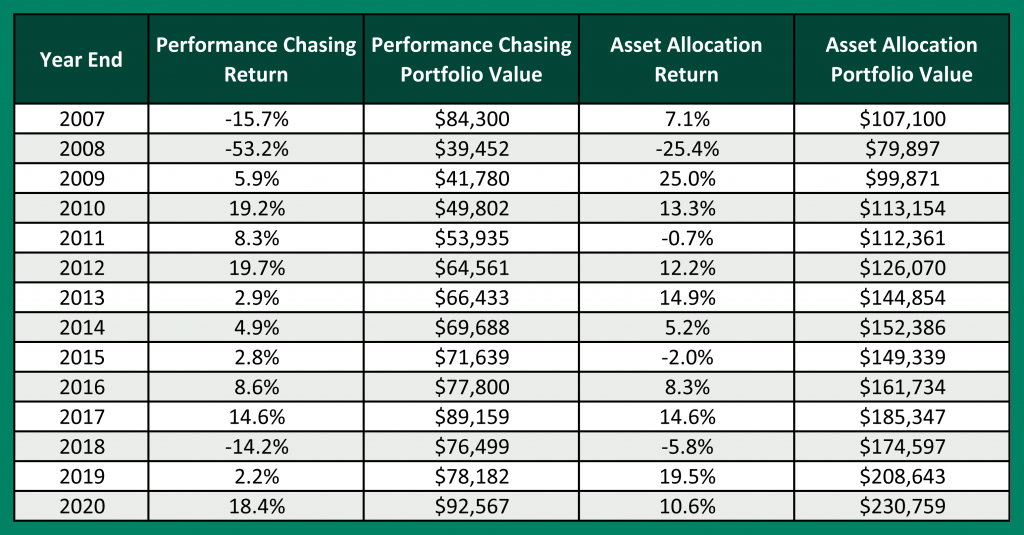
The numbers speak for themselves. Let us look at how a performance chasing strategy compares to an asset allocation strategy. Let’s assume you had $200,000 to invest at the beginning of 2007. You put $100,000 into a performance chasing strategy that invested in last year’s best performing asset class, and $100,000 into an asset allocation based upon the chart above. How would each strategy perform?
This is why we at GreenUp Wealth Management create a well-diversified investment portfolio for our clients using data driven research, avoiding performance chasing and the recency bias. Our goal is to get you to your destination, without aimlessly jumping between traffic lanes and creating unnecessary risk. At GreenUp we take a forward-looking approach to navigate the ever-changing investment landscape, creating portfolios that are customized to your objectives and risk level. Please contact your GreenUp Wealth Advisor to discuss these concepts in more detail and how they fit into your investment portfolio and financial plan.
Summary
- Chasing returns is the behavior of selling investments that have not performed well recently and buying those that are “hot.”
- Humans are inclined to chase returns because of the recency bias.
- Chasing returns typically leads to an underperforming investment portfolio as shown by historical data.
- Over the long run, diversified asset allocation strategies have historically outperformed performance chasing strategies with less risk.
Author
The GreenUp Wealth Management Team
Real advice, real people, and years of experience helping both pre-retirees and retirees pursue their dreams and grow their wealth for a comfortable retirement and fulfilling legacy. Working with GreenUp means getting conflict free advice from advisors who care. The GreenUp team has years of experience helping people pursue their goals and grow their wealth. We will create a financial guide for your life so that your wealth works for you. To learn more, or to get a complimentary portfolio/retirement plan/financial plan review, schedule time to meet with us below.
All Posts