Q4 2025 Market Update & 2026 Outlook – Achieving 20/20 Financial Vision
January 9, 2026 | Market Updates
GreenUp Wealth Management reviews Q4 2025 market trends and shares its 2026 outlook, including consumer strength, Fed policy, corporate earnings, valuations, and portfolio strategy.
Introduction: Calibrating Our Vision for the Year Ahead
Happy New Year! With every new year, our household starts a new checklist and at the top of the list is an annual visit to the optometrist. I may not know much about vision care, but my optometrist has a clear goal for me: achieving balanced 20/20 vision. We don’t aim for the vision of a falcon, capable of spotting details miles away, as that extreme far-sightedness would make it impossible to enjoy simple pleasures like reading a book. Nor is our goal to become so nearsighted that the horizon blurs while making things like driving become impossible. The ideal state is a calibrated perspective, clear and functional for navigating the world as it is.
This same principle applies to managing your wealth. Your customized financial plan from GreenUp Wealth Management is your 20/20 vision, carefully calibrated to provide the ideal balance between identifying long-term growth opportunities to mitigate inflation while avoiding near-term risks to principal as your need for the money draws near.
As we roll into 2026, GreenUp Wealth Management views the economic landscape with calibrated optimism, much like achieving balanced 20/20 vision. Just as extreme farsightedness might overlook immediate details while excessive near-sightedness blurs the distant horizon, an overly distant or shortsighted perspective can distort investment decisions. Our outlook strikes a balanced view, anticipating another year of positive stock market performance supported by resilient fundamentals.
This forward-looking thesis is anchored in three key pillars that provide clear near-term stability and far-sighted growth potential:
- A healthy consumer, offering near-sighted resilience through sustained employment and spending power;
- Supportive fiscal policy (the Federal Government tax and spending policy) and monetary policy (where the Federal Reserve controls the amount of money in our system) delivering far-sighted tailwinds via accommodative measures and stimulus;
- Robust growth in corporate earnings, the foundation for sustained market advancement.
These layers are not isolated; they are interrelated. Much of today’s investor anxiety comes from fixating on the outermost one and projecting a single outcome: recession. But contraction is not the only story these conditions can tell. At GreenUp Wealth, we believe peeling back the layers reveals a path toward growth, not away from it.
1. The Near-Sighted View: Assessing Today’s Consumer and Labor Landscape
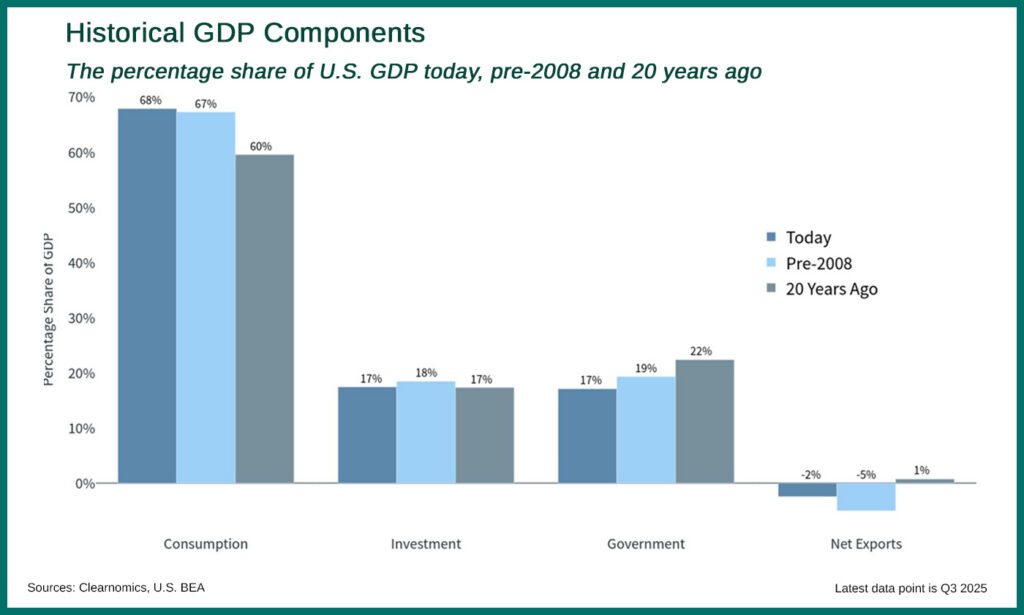
To understand the immediate market environment, we must first apply a “near-sighted” lens, focusing on the fundamental factors that will drive economic activity in the coming months. The most critical of these are the health of the U.S. consumer and the corresponding state of the labor market, which together dictate the trajectory of domestic spending. Domestic Spending is responsible for roughly 70% of the yearly economic growth in the USA. If the health of the consumer deteriorates, the effect would be seen immediately in the economy.
Consumer Resilience
The American consumer remains resilient, but is showing signs of cracking, which makes sense as the cost of goods has increased 23.7% over the last 5 years. At the same time, the cost of borrowing money is at its highest point since the end of 2007. However, the consumer continues to spend while increasing their total saved assets, clearly a positive sign. Positive wage growth of +3.9% continues to outpace headline inflation of 2.79% as measured by the Personal Consumption Expenditures Price Index or PCE, providing a net gain in purchasing power. Consumer spending growth, at +3.38% year-over-year, is stable, although slightly lower than its 30-year average of 4.28%. In short, the consumer continues to be foundational to the growth and stability of the US economy
These factors are not enough to change our expectations on positive consumer spending for 2026, but they do explain how the consumer feels as we have consistently seen persistently low consumer sentiment. For now, household debt remains well-anchored, largely supported by homeowners who have locked in historically low-interest-rate mortgages, providing a crucial buffer for the economy.
Labor Market Cracks
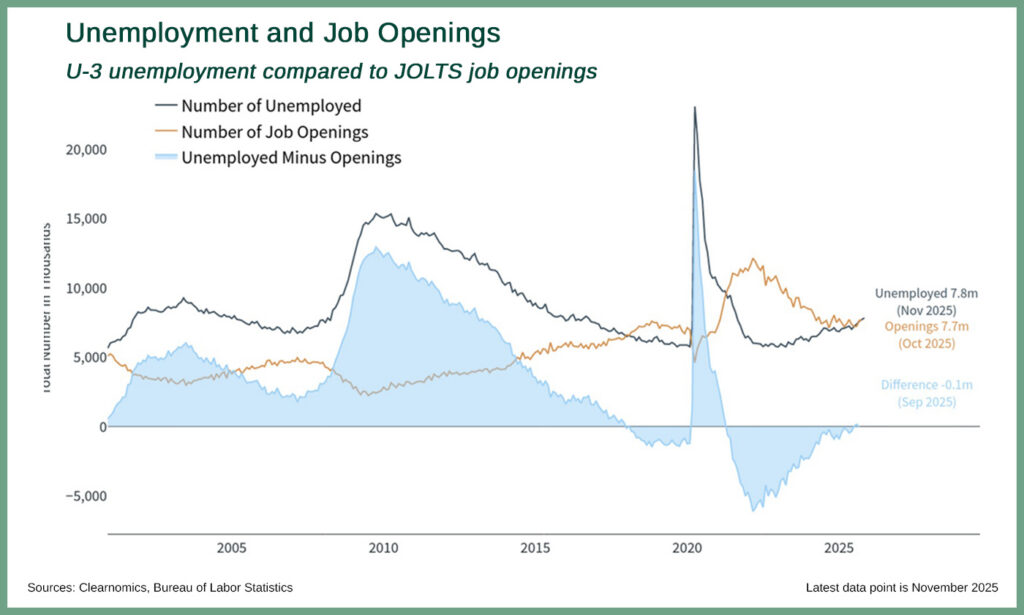
The strength of the consumer must be supported by the labor market. Currently, the US economy sits close to “Full Employment” (a point theorized to be the maximum level of employment an economy) can exhibit without triggering employment-driven inflation. There are roughly 7.8 million individuals looking for work and 7.67 million job openings, which is a great situation, however, there are clear signs of deterioration in the labor market. The unemployment rate has risen from 4.2% last quarter to 4.6%, signaling that the peak for employment in this economic cycle has likely passed.
Historically, technology has disrupted certain employment while creating new jobs, and in fact, more new jobs have been created than destroyed throughout past technological cycles. The jury is still out on how AI is impacting labor. Complicating the picture, a recent government shutdown has delayed official data releases making government statistics murky and forcing a greater reliance on private payroll data, which has thus far remained healthy. At GreenUp Wealth Management, our assessment is that while the jobs data is concerning, the positive fundamentals supporting consumer spending are currently more meaningful for economic stability.
2. The Far-Sighted View: The Policy Shaping Long-Term Growth
With our near-term view established, we now switch to a “far-sighted” lens to analyze the fiscal and monetary policies shaping the landscape. These decisions establish the long-term expectations for growth, inflation, and liquidity that are critical for investment performance and at this current point, both the Federal Reserve and the Federal Government are being supportive of US economic growth.
Monetary Policy & The Inflation Picture
The Federal Reserve has adopted a dovish stance, which is broadly supportive of the market. As mentioned above, key inflation metrics remain persistent, with headline Personal Consumption Expenditures (PCE) at 2.79% and core PCE (excludes food and energy prices) at 2.83%, the Federal Reserve has decided that these measurement levels are within an acceptable range for continued economic stimulus.
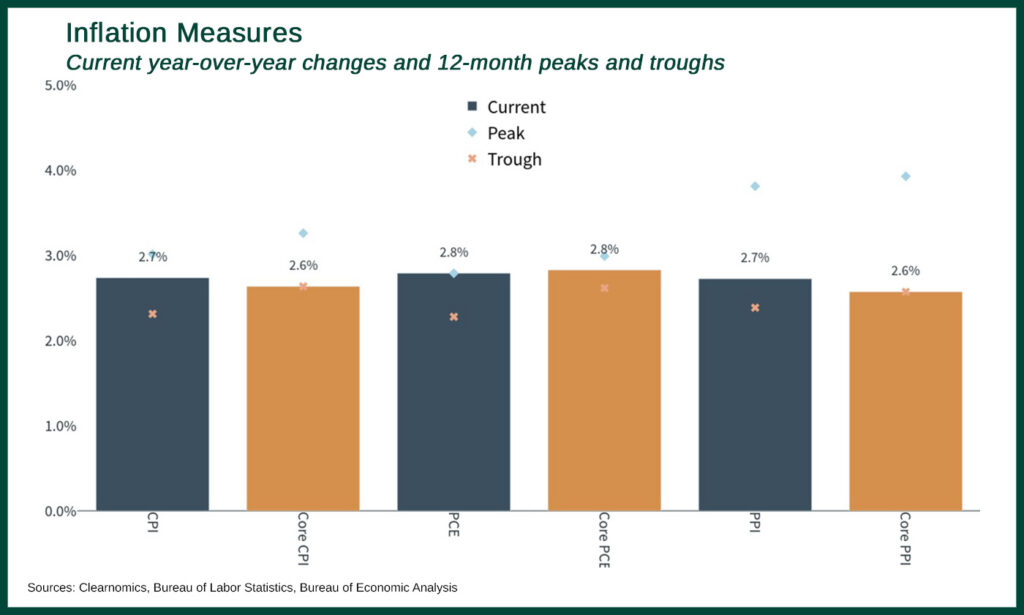
Because of this stable inflation picture, we expect the Fed to continue cutting the Federal Funds Rate until a target of 3.0% has been reached. These rate cuts will be positive for market liquidity and growth. While short-term rates should see more reduction than long-term rates, all borrowing costs are expected to decrease – including mortgages and car loans. The consumer should see these actions as a welcome reprieve, even with continued inflation, lower borrowing rates will go a long way towards clearing up the view of consumer health.
Fiscal Policy & Stimulus
It may not seem like the case, but the Federal Reserve and the Federal Government appear to be looking through the same lens. Government fiscal policy remains highly accommodative. The recently passed budget includes a $1.6 trillion deficit with a long-term goal of around $930 billion per year. I may not be able to explain to you why the US government continues to spend significantly more than the tax revenues they receive, especially while corporate profits continue to be on fire. What I can tell you is that this stimulus has a direct impact on consumers, as new tax advantages and potential tariff refunds are likely to result in larger tax returns or direct stimulus checks. This injection of capital will support continued consumer spending into 2026. While these policies will make it difficult to bring inflation below 2.5%, we expect it to remain within an acceptable range. This combination of supportive macro policies is projected to support annualized revenue growth of 4.9% or more, creating a favorable environment for “Corporate America,” which is truly the engine of the market.
3. The Murky Corporate Picture: Robust Earnings Against High Valuations
The performance of stock markets is fundamentally driven by corporate earnings over the long term. In the current environment, investors face a complex decision: whether to prioritize anticipated earnings growth or to account for the potential constraints imposed by elevated market valuations.
At GreenUp Wealth Management, we achieve clarity in uncertain conditions by simplifying and distinguishing key factors. Strong corporate earnings growth is projected at approximately 15% for companies that make up the S&P 500 in 2026. This is supported by ongoing technological advancements, particularly in artificial intelligence, which are expected to propel markets to substantial gains over the next five to ten years. However, elevated valuations may introduce periods of heightened volatility in the near term, particularly if earnings fall short of ambitious forecasts. This dynamic underscores the importance of a disciplined, long-term perspective focused on fundamentals.
Analysis of Corporate Profitability
The corporate earnings environment is exceptionally robust. So robust, in fact, that I cannot recall a more optimistic period in the last two decades. The data from 2025 painted a clear picture of strength and outperformance:
- Q3 2025 Earnings Growth: A remarkable +13.4% year-over-year.
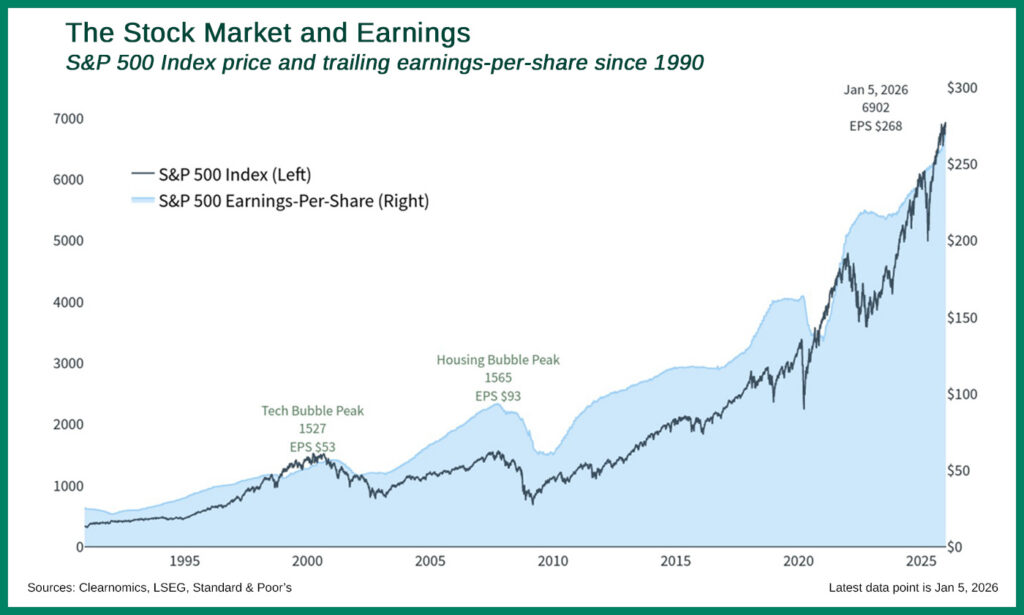
- 2025 Final EPS: Final earnings per share (EPS) landed near $272.50, substantially beating analyst forecasts.
- 2026 Mean EPS Forecast: Analysts now forecast 2026 EPS of approximately $310 per share, representing an expected 15% increase. This powerful earnings growth trajectory is the primary factor correlated to stock index performance, providing a strong fundamental underpinning for the market.
Evaluation of Market Valuation
Despite this strength, we must provide a sober assessment of current market valuations. Key valuation multiples for the S&P 500, which are commonly used to assess whether the stock market is overvalued or undervalued, currently indicate a level of expensiveness that has been exceeded in only approximately 5% of historical observations. In other words, 95% of the time, the market has been cheaper than it is today.
This elevated valuation introduces meaningful risk for investors, primarily in the form of increased volatility in their investments, not a sustained decrease in their investments. The principal driver of potential market volatility in 2026 would likely be actual corporate earnings falling short of consensus expectations. However, such a downturn appears unlikely to persist, given the anticipation of robust corporate earnings growth as a sustained secular trend. In particular, any shortfall in near-term earnings growth is expected to be offset by subsequent periods of expansion.
Conclusion: Our Portfolio Strategy for 2026
As we embark on 2026, the economic outlook is underpinned by resilient consumer fundamentals, supportive fiscal and monetary policies, and strong projected corporate earnings growth. However, elevated market valuations highlight the need for a disciplined and prudent approach to investing.
A critical insight from behavioral finance is that most investors do not abandon their strategies due to insufficient long-term returns but rather because they find it difficult to tolerate interim volatility. Such emotional reactions frequently result in suboptimal decisions, including selling assets at inopportune times and forgoing subsequent recoveries.
If you have concerns over these risks and the associated short-term volatility, we recommend arranging a meeting with your wealth advisor at GreenUp Wealth Management. This consultation will allow us to zoom out on your short and long-term goals, making sure your portfolio is in line with your unique objectives. We have a wide range of investment strategies to align your financial plan for multiple market environments.
At GreenUp Wealth Management, it is our pleasure to provide you with a clear perspective on 2026, enabling the formulation of a well-informed investment strategy for the year ahead.
GreenUp Portfolio Updates
Dynamic/ESG Models:
New Positions: NLR (VanEck Uranium and Nuclear ETF)
Exited Positions: N/A
Equity Income Model
New Positions: SPG (Simon Property Group, Inc.)
Exited Positions: Removed HSBC (HSBC Holdings plc)
Large Cap Stock Model
New Positions: COIN (Coinbase Global, Inc.), CRM (Salesforce, Inc.), DIS (The Walt Disney Co.), CRWV (CoreWeave, Inc.)
Exited Positions: LLY (Eli Lilly & Co.), KO (The Coca-Cola Co.), PYPL (PayPal Holdings, Inc.), FSLR (First Solar, Inc.), ABNB (Airbnb, Inc.)
Tactical Equity Model
New Position: N/A
Exited Position: N/A
GreenUp Street Wealth Management, LLC d/b/a GreenUp Wealth Management is an investment advisory firm registered with the Securities and Exchange Commission (“SEC”) under the Investment Advisers Act of 1940. Registration as an investment adviser does not imply a certain level of skill or training. The oral and written communications of an adviser provide you with information about which you determine to hire or retain an adviser. Form ADV Part 2A can be obtained by visiting https://adviserinfo.sec.gov and searching for our firm name. ADV Form 2B is available upon request. Neither the information nor any opinion expressed is to be construed as solicitation to buy or sell a security or personalized investment, tax, or legal advice.
This report has been provided for informational purposes only and is not intended as legal or investment advice or a recommendation of any particular security or strategy. The investment strategy and themes discussed herein may be unsuitable for investors depending on their specific investment objectives and financial situation. Information obtained from third-party sources is believed to be reliable though its accuracy is not guaranteed. Opinions expressed in this commentary reflect subjective judgments of the author based on conditions at the time of publication and are subject to change without notice. Past performance is not indicative of future results.
Any forecasts presented in this document, including estimates of returns or performance, are “forward looking statements”, are based upon certain assumptions about future events or conditions and are intended only to illustrate hypothetical results under those assumptions, and no assurances can be made that they will materialize. Forward-looking statements are based on an assumption that economic, market, political, operational, legal, tax, regulatory and other conditions will not deteriorate and, in some cases, improve.
Definitions:
Personal Consumption Expenditure (PCE) – a measure of the prices that people living in the United States, or those buying on their behalf, pay for goods and services. The PCE price index is known for capturing inflation (or deflation) across a wide range of consumer expenses and reflecting changes in consumer behavior.
S&P 500 – measures the performance of 500 widely held stocks in US equity market. Standard and Poor’s chooses member companies for the index based on market size, liquidity and industry group representation. Included are the stocks of industrial, financial, utility, and transportation companies. Since mid-1989, this composition has been more flexible and the number of issues in each sector has varied. It is market-capitalization weighted.
Author

Daniel Greulich, CFA CFP®
Chief Investment Officer | Wealth Advisor | Ann Arbor, MI -- Daniel leads our Investment Committee and partners with Aaron Kirsch, Chief Client Advocacy Officer to design and implement client portfolios with your advisor. Daniel brings 14 years of practical experience as a trader, financial advisor, and money manager at both large and mid-sized financial services companies to GreenUp Wealth Management. In addition, he holds a CFP® designation and is also a CFA charterholder. This combination of experience and knowledge helps Dan confidently guide his clients through the development, execution and monitoring of their customized financial plans.
All Posts