Quarterly Market Commentary: Acknowledging the Bull Market
July 11, 2024 | Market Updates
GreenUp Wealth Management reviews Q2 2024 market momentum, earnings growth, consumer strength, Fed policy, AI trends, and portfolio updates.
It’s been an incredible year so far: the Fed’s highly-anticipated “Soft Landing” caused concern about the pace of a slowing economy, but as we conclude the 2nd quarter of 2024, there has been no landing, nor has the economy slowed. On the contrary, we have seen continued economic growth. The “Soft Landing” thesis has not been borne out. At Greenup, we expect to see continued growth in Q3, even if slowed from its current pace.
A quick recap of 2024 is helpful in understanding our current outlook. At the beginning of 2024, we anticipated the S&P 500 would end the year at 5400. However, it currently sits at approximately 5500, suggesting the market may be overextended. While some might interpret this as a sign that the market will be flat to down over the next six months, our view at Greenup is more nuanced. Although we do expect the S&P 500 to slow down its growth trajectory[1] through the remainder of 2024, we also foresee double-digit earnings growth through 2027. While we are not audacious enough to predict the exact timing of these gains, we remain confident in the market’s direction and momentum.
For the reasons I will discuss below, this is a time for savvy investors to review their plans in preparation for taking advantage of the opportunities and protecting against the volatility that this market will hold.
The Stock Market Has Robust Momentum
For the last year, the stock market that has outpaced both earnings and economic growth. In fact, the S&P 500 has been rapidly moving upward since October 2022 when it bottomed at 3588, and has since returned +53%. If past Bull Markets are any indicator, market growth is clearly not finished. Since 1960, the typical Bull Market has lasted about five years on average and returned 165%. If history has anything to say, this current market cycle still has some legs.
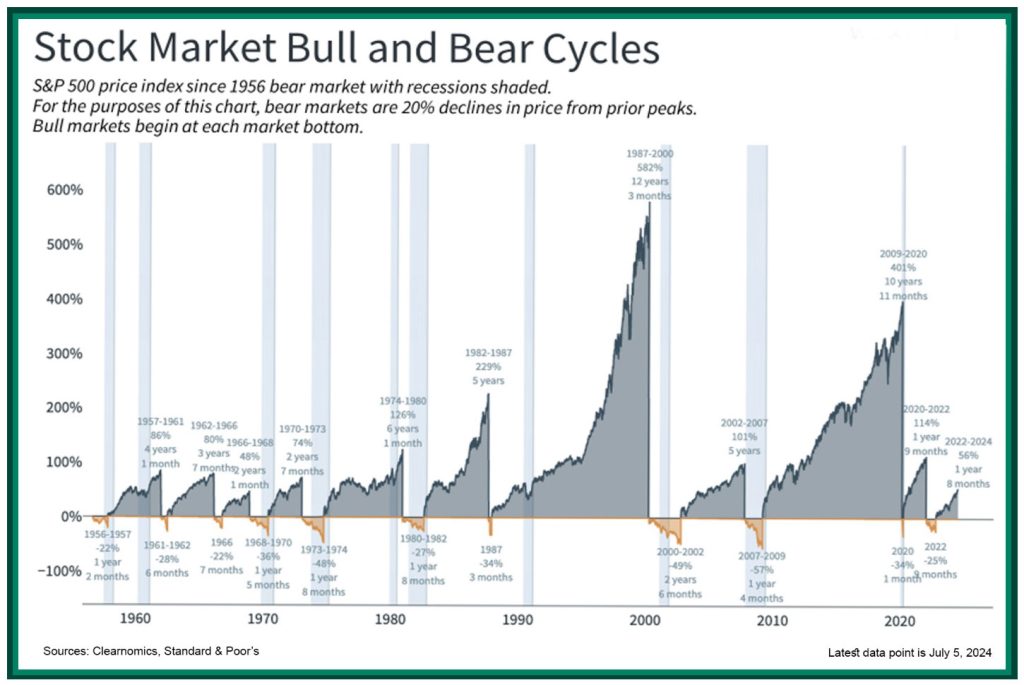
Although historical performance gives us a nice road map for what could happen, at GreenUp our Investment Committee has laid its morals on Fundamental Analysis: we base our analysis on how much a company takes in (revenue), spends (expenses), and keeps (profit margins). It is nice if companies have performed well in the past when there have been similar market conditions, but our ideal investing conditions occur when these environmental conditions pair with improving earnings, which is exactly what we have seen. In the absence of improving earnings, concerns surrounding the sustainability of our most recent Bull Market are valid. Through 2024, market analysts have raised their expected earnings growth from the mid-to-low single digits of the last two quarters into double-digit territory for 2025, 2026, and 2027.
Our belief in the long-term growth potential of the market remains steadfast. The S&P 500’s current position reflects a significant year-to-date increase of approximately 15%. This growth, while impressive, is expected to stall slightly as we move through the rest of 2024 and earnings catch up. Nonetheless, we are confident that the underlying factors driving earnings such as a growing economy driven by a stable consumer, increasing revenue, and profit margins, as well as the expected stimulus from the Federal Reserve, will support robust growth into the mid-teens through 2027.
A Strong Job Market is Supporting a Growing Economy
Several key factors contribute to our optimistic economic forecast, but first and foremost our thesis is supported by a healthy consumer. The consumer is responsible for ~68% of the economic growth in the USA. A strong job market is anchored by substantial employment opportunities and growing wages. The Job Openings and Labor Turnover Survey (JOLTS) indicates the number of job openings in the USA. Currently, there are 8.1 million job openings indicating a strong demand for labor. But JOLTS have decreased by 1.7 million jobs over the past 12 months, giving us a stark reminder that the jobs market will not be supportive of the economy indefinitely.
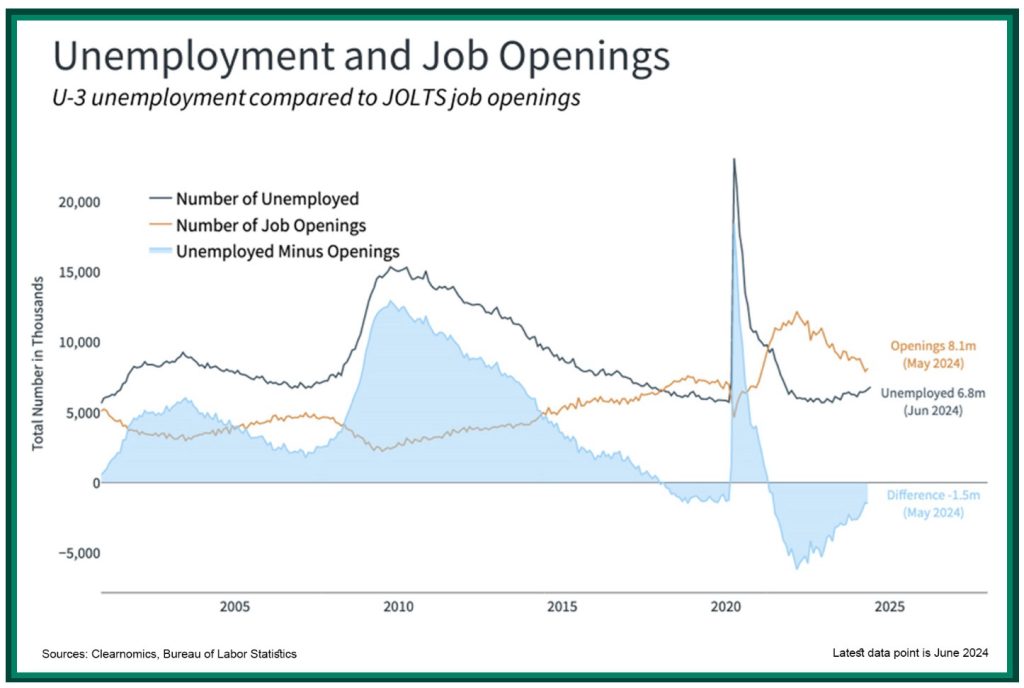
Although that day will come, it is not here yet. As this deteriorating but robust employment landscape is complemented by wage growth which remains steady at 4.0%. This balance between job availability and wage stability supports consumer spending and economic activity, forming a solid foundation for continued economic expansion.
AI Will Spark Corporate Earnings Growth
Our forecast for double-digit earnings growth through 2027 is underpinned by the positive trends exhibited in Corporate America. But many investors are asking: can we really expect earnings growth to accelerate while wage growth continues to be higher than inflation? The answer is yes. But Corporate America is in need of a spark to improve efficiency and/or productivity.
Enter: Artificial Intelligence (AI). Although it is intriguing to think about the promise of AI-controlled robots manicuring my front yard while I am enjoying a cocktail, we may be more than a few years out from this reality. But right now, AI is fantastic at assisting in administrative tasks. 65% of companies are reporting regularly using generative AI across all business functions–that’s twice the rate of adoption over 2023 – and seeing yields from that effort too.[2] For example, employees who adopt AI are spending ~ 30% less time on administrative tasks – and since administrative tasks are essential to every business function, the results are far-reaching. We measure this improvement in the form of increased profit margins (the percentage of revenue that a company keeps after paying all expenses for the year).
As of the 4th quarter of 2023, the profit margin for the S&P 500 sat at 11.7% or for every $1 earned by a company in the S&P 500, 11.7 cents was saved by the company after paying all of its expenses. In utilizing more efficient technology combined with a growing economy and a healthy consumer, the US economy should continue to grow and financial markets should continue their Bull Market run, even if some of the future growth is already priced into the market.
The Fed Put is Back
There has been a lot of commotion about how quickly and to what extent the Federal Reserve will lower the Federal Fund Rate, but there has been an important development: inflation has stabilized. The “Fed Put” is back in play.
What is the “Fed Put”? It is a widely held belief by the investment community that if the market were to contract and fall into or towards a recession, the Federal Reserve would intervene and stimulate the economy, such as lowering the Fed Funds Rate.
Why is this important? The answer lies in the perspective of investors. If interest rates are lowered by the Federal Reserve to stimulate an economy in recession, investors will be cautious because of the current recession they find themselves in. Recessions are not to be taken lightly and exiting such markets can be precarious. But if an investor finds themselves in an environment where the economy is growing and with the Federal Reserve still willing and able to lower interest rates, investors will take more risk than normal. If the financial markets show cracks, the stimulus provided by the Federal Reserve will lessen or even completely eliminate any loss potential from an investor. This mentality from investors helps explain why the market is so expensive from a valuation standpoint and should continue to support the upwards market momentum.
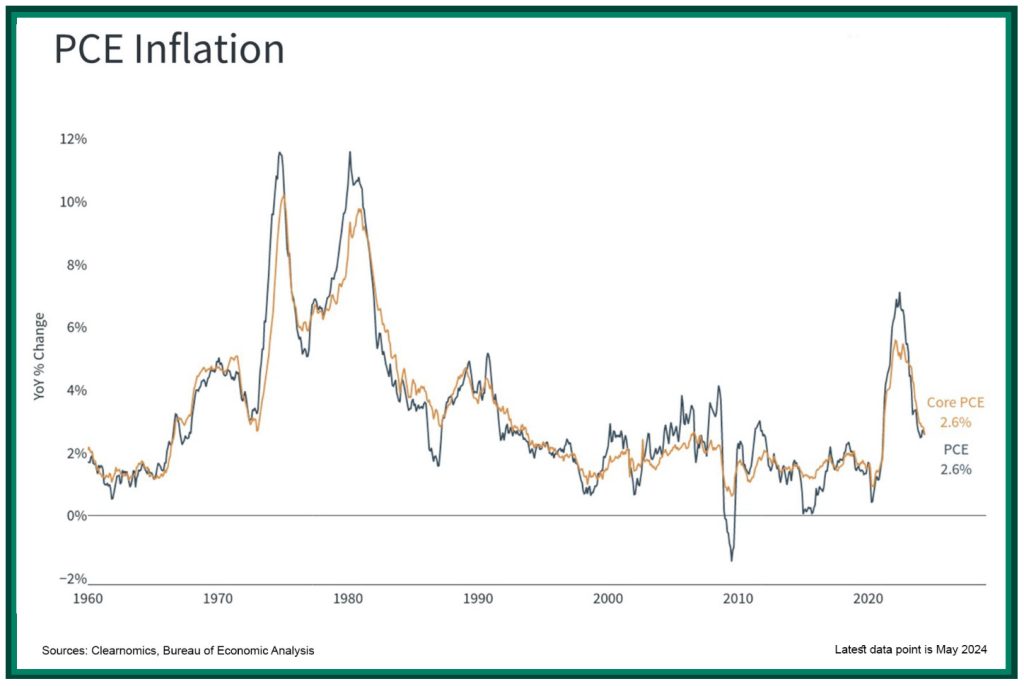
As market mentality has shifted from a recessionary “hard landing” to a growth-oriented “no landing” scenario, the Fed Put is back in play. The main deterrent of lowering interest rates would be an increase in inflation. The good news is inflation has been trending in the right direction. The Federal Reserve Board’s preferred metric to gauge inflation (Personal Consumption Expenditure or PCE) sits at 2.65%, just above the FEDERAL Reserves goal of 2-2.5%. In fact, PCE has been sub-3 % since October 2023. Although PCE has shown some stickiness, the measurement is within striking distance of the Federal Reserve’s target.
Now that inflation in an acceptable range, we anticipate that even if economic growth experiences a slowdown, it will be cushioned by the “Fed Put.” In scenarios where economic momentum wanes, the Federal Reserve is likely to accelerate the decrease in the Fed Funds Rate, providing a safety net that supports both economic stability and market growth.
The Greenup Approach to Q3 Investing
As we move forward, it is essential to remain vigilant and adaptable to market conditions. While the short-term outlook may include periods of volatility and slower growth, the long-term trajectory remains positive. Our investment strategies will continue to focus on combining a presence towards undervalued companies with strong earnings potential and sustainable growth drivers. Diversification will remain a cornerstone of our approach, helping to mitigate risks and capture opportunities across different market segments. Although Large Cap Stocks can be considered expensive, Mid and Small Cap companies are considered cheap and should benefit from adopting AI. By maintaining a well-diversified portfolio, we can better navigate the uncertainties of the market while positioning ourselves to capture future growth in other primed aspects of the market. We will continue to monitor economic indicators, market trends, and policy developments closely. At GreenUp we acknowledge that inflation measurements can be volatile and it is a Presidential election year. This vigilance allows us to make informed adjustments to our strategies, ensuring that we are well-positioned to capitalize on emerging opportunities and address potential challenges.
This is an exciting market, rife with opportunity, but the gains will be more segmented, and it will also be volatile – because there are high expectations for earnings growth that are already backed into the market. We encourage Greenup clients to schedule a call with their advisors to review their goals as we enter the second half of this year.
As always, our commitment is to provide you with insightful analysis and strategic guidance to help you achieve your financial goals. We appreciate your trust and partnership and look forward to navigating the future together.
[1] For reference, the index is currently up ~15% year-to-date.
[2] The state of AI in early 2024. Quantum Black x McKinsey. May 30, 2024.
GreenUp Portfolio Updates
Dynamic Portfolios
We continue to overweight domestic stocks and Healthcare. We reduced our Small Cap Value exposure from 4% to 3% and removed the Cambiar SMID Investor fund (CAMMX).
Equity Income Model
We replaced Bristol-Myers Squibb Co. (BMY) and Gilead Sciences Inc. (GILD) with MPLX LP (MPLX), The J.M. Smucker Co. (SJM), and HSBC Holdings plc (HSBC).
Tactical Equity Model
We sold SPDR S&P Midcap 400 ETF (MDY) and bought iShares MSCI EAFE ETF (EFA).
Tactical Income Model
We sold SPDR Bloomberg Convertible Securities ETF (CWB) and Invesco Exchange Traded Fund Tr Emerging Market SVRG (PCY). We bought VanEck High Yield Muni ETF (HYD) and Invesco Preferred ETF (PGX)
Past performance is not indicative of future results. The material above has been provided for informational purposes only and is not intended as legal or investment advice or a recommendation of any particular security or strategy. The investment strategy and themes discussed herein may be unsuitable for investors depending on their specific investment objectives and financial situation. Information obtained from third-party sources is believed to be reliable though its accuracy is not guaranteed, and GreenUp makes no representation or warranty as to the accuracy or completeness of the information, which should not be used as the basis of any investment decision. Information contained on third party websites that GreenUp may link to are not reviewed in their entirety for accuracy and GreenUp assumes no liability for the information contained on these websites. Opinions expressed in this commentary reflect subjective judgments of the author based on conditions at the time of writing and are subject to change without notice. No part of this material may be reproduced in any form, or referred to in any other publication, without express written permission from Firm. For more information about GreenUp including our Form ADV brochures, please visit https://adviserinfo.sec.gov
Author

Daniel Greulich, CFA CFP®
Chief Investment Officer | Wealth Advisor | Ann Arbor, MI -- Daniel leads our Investment Committee and partners with Aaron Kirsch, Chief Client Advocacy Officer to design and implement client portfolios with your advisor. Daniel brings 14 years of practical experience as a trader, financial advisor, and money manager at both large and mid-sized financial services companies to GreenUp Wealth Management. In addition, he holds a CFP® designation and is also a CFA charterholder. This combination of experience and knowledge helps Dan confidently guide his clients through the development, execution and monitoring of their customized financial plans.
All Posts